Tuesday, October 14, 2014
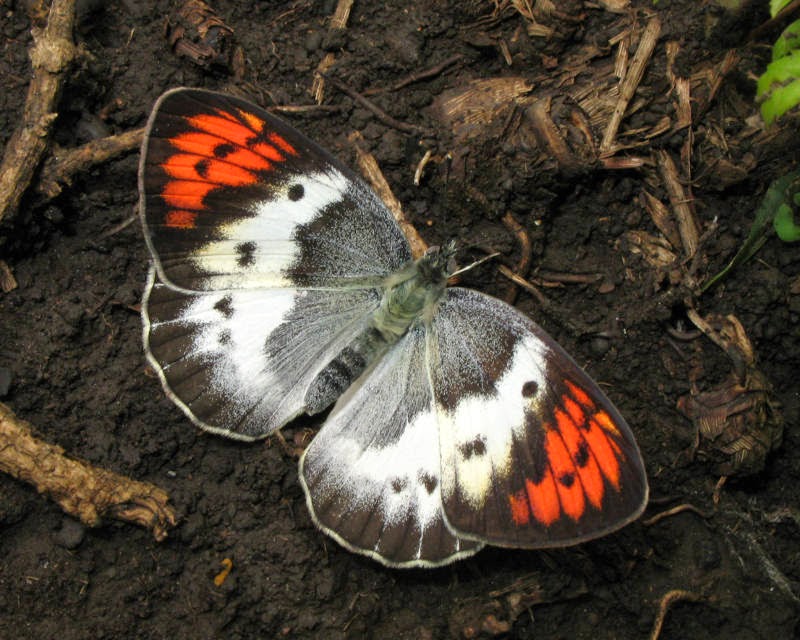
Colotis annae
More of the Scarlet Tip. These two magnificent individuals, male and female, were at a butterfly party in Bisley Nature Reserve. They are in exuberant summer form.
See also the previous post on this butterfly.
Monday, October 13, 2014
Acraea oncaea
Acraea oncaea or the Window Acraea. Second from the top is a male, then next a female with the same colour as the male but told apart by the white apical patches. Next is the underside of this butterfly.
At bottom is the brown form of the female. I also think there is sphragis (a mating plug) on the posterior of her abdomen.
Friday, September 26, 2014
Euchrysops osiris
This is the Osiris Smoky Blue.
We found it at Cumberland, going down the Lolombazo gorge. It is my only record, we are at the southernmost limit of its distribution.
The upper-side is that of a male.
Wednesday, September 17, 2014
Anthene definita
The Common Hairtail, there are three "hairtails" extending from the posterior end of the hind-wing.
The butterfly here is a female, the male is all metallic blue on the upperside.
It is not all that common here, this one was found at Bisley Nature Reserve.
Saturday, August 30, 2014
Catacroptera cloanthe
The Pirate, perhaps so named after the hairiness of the DSF. The winter form has richer ground colours, and is a lot more hairy, quite different from the WSF. The upper-side basal blue is only evident under certain lighting.
Thursday, August 28, 2014
Zerenopsis lepida
The Cycad Looper Moth, the larvae can demolish a Cycad in a few days.
It is larger than but remarkably similar to the Polka Dot butterfly, Pardopsis punctatissima.
Sunday, August 24, 2014
Eurema hecabe
Hecabe, named after the wife of Priam in Eurides' play of the fall of Troy.
According to Markku Savela's site, the taxon has been revised no less than 56 times, the TS being Papilio hecabe Linnnaeus 1758.
Despite its common name the Common Grass Yellow (also the Low veld Yellow,) this is appears to be the least common of our three Eurema, I have only two records, both shown here. The top one I forgot to document; the bottom two are of the same individual in our garden on an invasive balloon vine (Cardiospermum grandiflorum.)
The underside markings are similar to E. Desjardensii, but but the scalloped upper side marginal band (seen contre-jour here) and the rounded hind wing set it apart.
Steve Woodhall mentions an unnamed WSF found in Kwazulu-Natal that lacks the underside apical brown patch. There is just a hint of one in the top photo, but is entirely lacking in the bottom.
Our St John's wart (Hypericum aethiopicum) is one of its food plants.
Another one that I had previously misnamed. The butterfly that came to an untimely end had been captured by a Small Crab Spider (Thomisidae.)

Subscribe to:
Posts (Atom)