De rerum: an acknowlegement and explanation.
INDEX: Linnaean

Wednesday, September 21, 2011

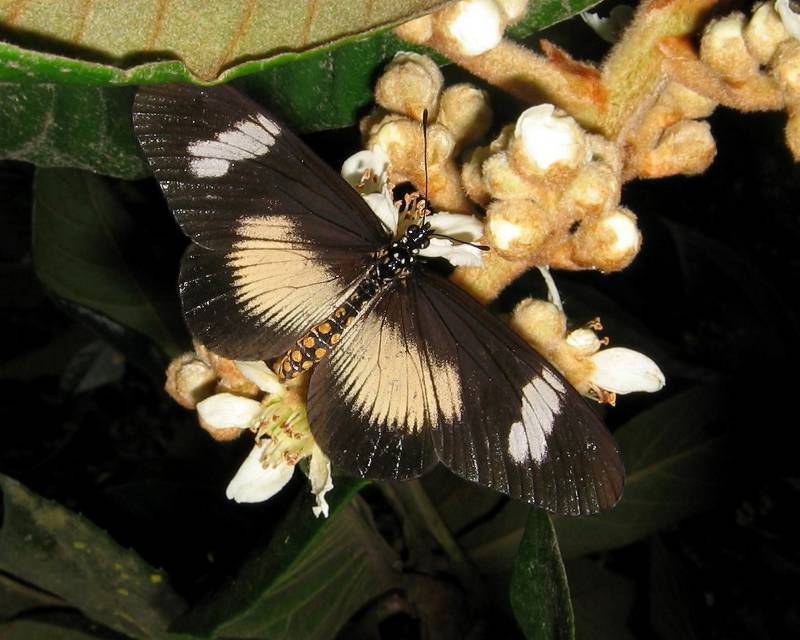
Amauris albimaculata


The Layman, told from our other three SA Amauris spp. by the broad hind wing band being a light ochre,  but the fore wing patches all white.
At top, a male in our garden showing off his sex brands. Below is the underside of an individual nectaring on the flowers of a Combretum molle at Cumberland. The elongated white patch on the palp also distinguishes it from A.echeria. As is common to other Danainae, food plants are from the Asclepiadaceae, and being distasteful to predators,this butterfly acts as a model for various Batesian mimics (e.g. Papilio dardanus, Hypolimnas anthedon f.mima)

Sunday, August 28, 2011

Zizina otis antanossa


Well, it appears that our Z. antanossa been lumped as a ssp. of Z. otis.
I found this fresh and robust butterfly at Cumberland in January, our mid-summer. I was not absolutely certain of the identification because of the aberrant underside hind wing disco-cellular spots. Starting at the top: the second spot, the position of which is diagnostic of the species, is entirely missing, and no. 5 is almost invisible.
(Compare this with my earlier posting Z. antanossa.)
Any comment re correct ID would be welcome.
(PS, entomologists count the veins the other way.)

Tuesday, August 23, 2011

Vanessa cardui (II)


The Painted Lady, or Vanessa of the thistle. Previously she was Cynthia of the thistle, used by Fabricius in 1807 as the type species to establish the genus Cynthia, before being assigned to his own genus Vanessa.
I just love the first specimen, up to her neck in the lavender flower.
(See also previous post on Vanessa.)
 

Friday, August 5, 2011

Telchinia esebria - forms


The Dusky  Acraea and mimicry.
The Telchinias are also known as the Bitter Acraeas because they are distasteful/ poisonous to predators, and advertise this with their aposematic colouring: reds, yellows and whites on a black background. As can be expected, mimicry will be the order of the day.
At the top is the form esebria, the red is alarming enough. The white sub-apical patches make her a female, (the male's would be ochre). She does have a resemblance to Papilio dardanus f. trophonius (Batesian.)
I came across some interesting publications on the role of the optix, (as well as invected and engrailed)  gene's role in the red pigment of the S. American Helioconius, and its part in mimicry and convergent evolution.
Next two pictures are of the ochrous form f. protea (our most common.) The larger of the mating pair with the white sub-apical markings is the female.
At the bottom is the form monteironis with white markings only.
The Acreaea (previously Bematistes) aganice is a Mullerian co-mimic of T. Esebria, the male of the male f. proteus, the female of f. monteironis. The unrelated Pseudacraea eurytus imitator is a Batesian mimic.
See also T. esebria (I), and Telchinia the genus.
I have started Bates' Naturalist on the River Amazons; a wonderful read. (various editions can be found on either Project Gutenberg, or archive.org.)

Tuesday, August 2, 2011

Telchinia esebria (I)


The Dusky Acraea, a common garden butterfly.
At top, the larger of the two mating would be the female.
Next a female ovipositing on the under surface of a stinging nettle leaf, the Urticaceae providing its foodplant.
A month later these eggs had hatched and the larvae well on their way.
(see also genus Telchinia., and  T.esebria - forms)    
    

Friday, July 22, 2011

Belenois gidica


The African Veined White
The top two pictures are of the same WSF male (with a clip out of fore wing apex.) He was found warming up in the company of a summer migration of Whites that had rested for the night in the KZN-NBG. I always recognise the male of this sp. by the silvery scaling in the white patches of the fore-wing apex.
Next a picture of the male DSF in the middle of winter, mud puddling in the garden. Here the underside markings are a light brown instead of black.
At the bottom a female from Cumberland in all the glory of her extreme WSF. Compare her round bottom with the male's claspers.
The hind wing under side of both sexes is characteristic of the sp.: there is an extra row of dark markings proximal to border markings that, together with the veins, take the form of tridents.
(See also Belenois the genus.)

Sunday, July 17, 2011

Belenois aurota


The Brown-veined White.
The broad dark outlining of the veins on the underside are characteristic of the sp.: black in the male and brown in the female.
At top is a male at Bisley NR feeding on a Vernonia, a popular nectaring flower. The underside of this male butterfly has the yellow restricted to a few streaks, and on both surfaces the black of the apex  encloses some well demarcated white patches. In this specimen the disco-cellular marking is developed into a bar that merges with the costa.
Below is a female settling for the night in the KZN-NBG. As c.f. the male, the veins are outlined in brown and the yellow is more extensive. (Not shown, here the upperside black margin would be unrelieved by any white.)
Compare this with B. creona (see also Belenois the genus.)