De rerum: an acknowlegement and explanation.
INDEX: Linnaean

Tuesday, February 4, 2025

Imbrasia cytherea


 At least I am fairly sure that this is the Pine Emperor Moth. The picture was taken by Glenda in Plettenburg Bay. A large moth with lovely markings. Apparently a  pest in pine plantations. Is it now labelled Gonimbrasia cytheria?

Tuesday, December 5, 2023

Alaena amazoula


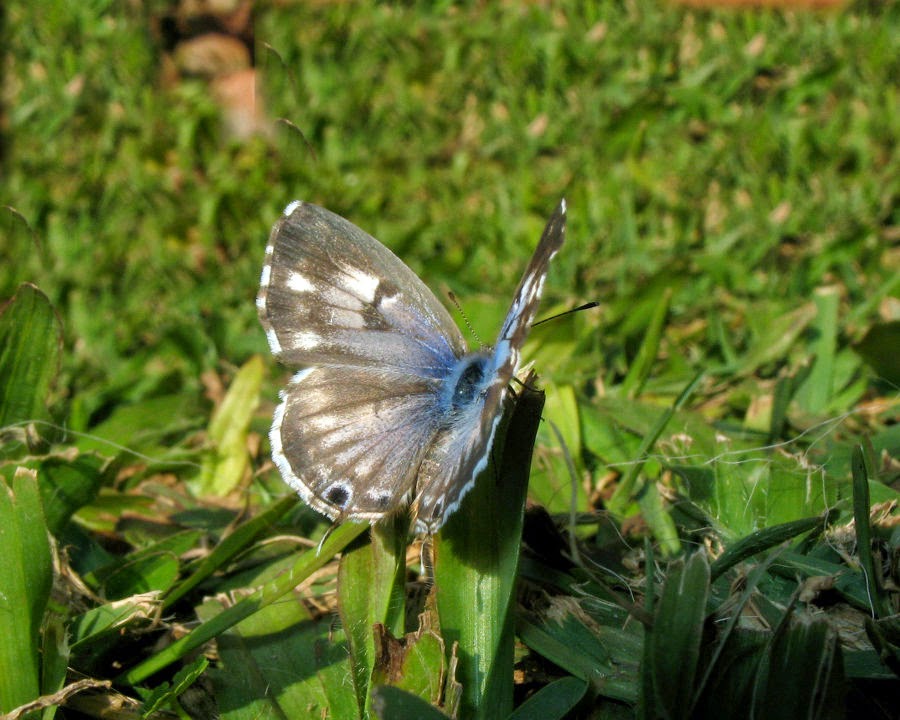
The Yellow Zulu. there were a number of the butterflies at Cumberland Nature Reserve.  Settling on grass stalks, in the morning sun they stood out like white flags. See other post. 

Sunday, July 2, 2023

Henotesia (Brakefieldia) perspicua


The Eyed Bush Brown, or Marsh Patroller, has now been reasigned to Brakefieldia perspicua.
At top the summer form (I sometimes have a problem distinguishing this from the summer form of the Common Bush brown.)
The bottom two, rather clinical photos, are of the winter form that visited us in our house and was photographed on a window pane.

Wednesday, June 21, 2023

Papilio dardanus


I found this Mocker Swallowtail at the pond of our retirement village. I have found it quite unusual to photograph the male with its wings open. See my earlier previus post on the female, which gives the reason for the name mocker.

Tuesday, May 2, 2023

Cymothoe alcimida


The female Battling Glider, so different from the male. 

Sunday, April 30, 2023

Byblia ilithyia


The Spotted Joker, told different from the Common Joker by the spots on the hind wing. I have found it just as common as the Common Joker.

Thursday, August 30, 2018

Cymothoe alcimeda

The Blonde Glider. At first I had mistaken it for the Battling Glider.
A first for me. It is not common, and is usually found closer to our east coast.
In fact this is the Battling Glider.

Monday, August 8, 2016

Acraea horta

The first Garden Acraea of the season.
 

Sunday, July 31, 2016

Precis archesia

A rather handsome Garden Inspector
 

Thursday, June 30, 2016

Charaxes zoolina


Club-tailed Emperor, two remarkably different seasonal forms. Above the DSF f. neanthes, that was in our garden. Below the WSF, f. zoolina, found by Mandy near the Mozambique border; sipping beer. Both have a single anal tail, making them males.
 

Saturday, May 7, 2016

Belenois zochalia


This butterfly would appear to be quite uncommon. This my one and only record, a lifer! I found it in our garden. The tracery on the underside of the hind wing is delicate. The yellow hind wing and cream fore wing make this a female.
 

Sunday, August 30, 2015

Colotis auxo (male)

This is the male Sulphur Orange Tip. The winter form has paler colours lacks the apical black border.
 

Saturday, August 29, 2015

Colotis auxo


Previously Colotis aurota, this is the Sulphur Orange Tip. At top a female, I think the bottom is also of a female. Some females seem to be bleached to all grey colours.  Incidentally the flower is a Commelina.
 

Friday, July 17, 2015

Moth

I came across this remarkable caterpillar, I don't know its identity. Presumably the appendages on its back act as a deterrent to parasitism by a wasp. Compare it with a previous posting of a Rhanidophora moth.
   

Monday, June 29, 2015

Pardopsis punctatissima


Although the flight period is mainly in summer, it can also br found in winter as was this butterfly.
It is sub-family Heliconiina and was originally described as Acraea punctatissima (Boisduval 1833.)
The genus Pardopsis is monospecific.
Here is a link to his colour illustration.
And here a link to my previous post.
 

Thursday, April 16, 2015

Hawk Moth


The closest I could get was family: Sphingidae. These are two different individuals, and don't know if they are the same sp. The larva is voracious, and they can destroy a pot plant overnight single-handed.
We call them Hawk Moths, the Americans Sphingids.
 

Monday, April 13, 2015

Notarcha quaternalis


It's not often I can name a moth, but this one came into our house one evening and was characteristic enough to be identified. It is found in central Africa, and in the NE of the RSA. Wingspan is about 2 cm. Its common name is the Fourth Pearl, pearl being applied to the most members of the subfamily Spilomelinae. Fourth refers to the specific name, but I don't know why Zeller 1852 named it thus.
 

Thursday, April 2, 2015

Cyana pretoriae


The Pretoria Red Line, this handsome moth is found in Central and Southern Africa. The diet is lichen. The family Arctiidae, it has similarly striped legs to its close relative the Tri-coloured Tiger.
The specific name for the city.
The genealogy of the name is as follows:
Both Cyana and Bizone Walker 1854
Bizone pretoriae Distant, 1897
Now Cyana pretoria (Distant 1897)

Friday, February 6, 2015

Cacyreus lingeus


This Bush-bronze butterfly was found frequently, possibly because of one of its food-plants, Plectranthus sp. is commonly grown here. The other Cacyreus is the Common Geranium Bronze, which although the underside has a resemblance to this sp., the upper side is a rich chocolate brown


Friday, January 30, 2015

Cacyreus marshalli


Again there was some uncertainty as to whether this is is the Common or the Water geranium Bronze, (C. marshalli or C. tespis which is now C. fracta. Apart from observation of the genitalia, the only feature would be how much coppery violet there is on the upper side.
See previous post on this blog.