Monday, June 29, 2015
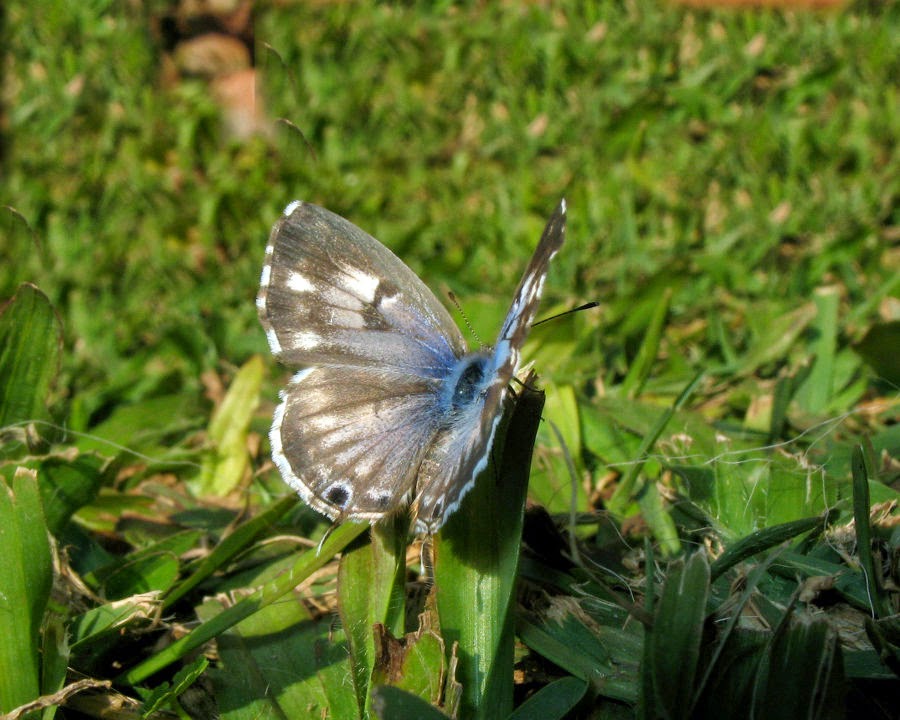
Pardopsis punctatissima
Although the flight period is mainly in summer, it can also br found in winter as was this butterfly.
It is sub-family Heliconiina and was originally described as Acraea punctatissima (Boisduval 1833.)
The genus Pardopsis is monospecific.
Here is a link to his colour illustration.
And here a link to my previous post.
Thursday, April 16, 2015
Hawk Moth
The closest I could get was family: Sphingidae. These are two different individuals, and don't know if they are the same sp. The larva is voracious, and they can destroy a pot plant overnight single-handed.
We call them Hawk Moths, the Americans Sphingids.
Monday, April 13, 2015
Notarcha quaternalis
It's not often I can name a moth, but this one came into our house one evening and was characteristic enough to be identified. It is found in central Africa, and in the NE of the RSA. Wingspan is about 2 cm. Its common name is the Fourth Pearl, pearl being applied to the most members of the subfamily Spilomelinae. Fourth refers to the specific name, but I don't know why Zeller 1852 named it thus.
Thursday, April 2, 2015
Cyana pretoriae
The specific name for the city.
The genealogy of the name is as follows:
Both Cyana and Bizone Walker 1854
Bizone pretoriae Distant, 1897
Now Cyana pretoria (Distant 1897)
Friday, February 6, 2015
Cacyreus lingeus
This Bush-bronze butterfly was found frequently, possibly because of one of its food-plants, Plectranthus sp. is commonly grown here. The other Cacyreus is the Common Geranium Bronze, which although the underside has a resemblance to this sp., the upper side is a rich chocolate brown
Friday, January 30, 2015
Cacyreus marshalli
Again there was some uncertainty as to whether this is is the Common or the Water geranium Bronze, (C. marshalli or C. tespis which is now C. fracta. Apart from observation of the genitalia, the only feature would be how much coppery violet there is on the upper side.
See previous post on this blog.
Monday, January 26, 2015
Teracolus eris
The Banded Gold Tip. Having been better known as Colotis eris, now reassigned back to T. eris (Butler 1897), who used sub-genus Teracolus (Swainson 1833). A pierid, it was first described Pieris eris Klug, 1829;
The female (bottom) lacks the violet and gold of the male.
Eris was the goddess of strife.
I had posted more of this butterfly on Butterfly party.
Subscribe to:
Posts (Atom)