Friday, July 22, 2011
Belenois gidica
The African Veined White
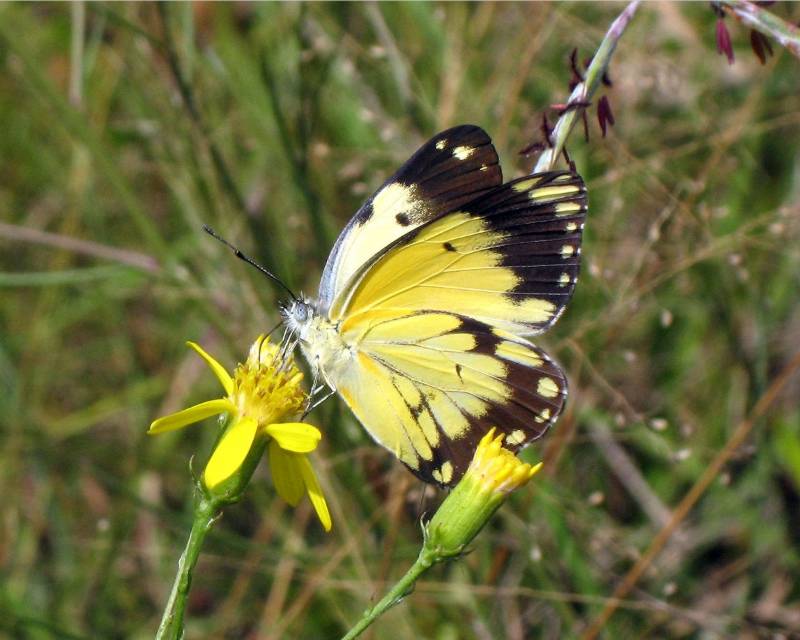
The top two pictures are of the same WSF male (with a clip out of fore wing apex.) He was found warming up in the company of a summer migration of Whites that had rested for the night in the KZN-NBG. I always recognise the male of this sp. by the silvery scaling in the white patches of the fore-wing apex.
Next a picture of the male DSF in the middle of winter, mud puddling in the garden. Here the underside markings are a light brown instead of black.
At the bottom a female from Cumberland in all the glory of her extreme WSF. Compare her round bottom with the male's claspers.
The hind wing under side of both sexes is characteristic of the sp.: there is an extra row of dark markings proximal to border markings that, together with the veins, take the form of tridents.
(See also Belenois the genus.)
Sunday, July 17, 2011
Belenois aurota
The Brown-veined White.
The broad dark outlining of the veins on the underside are characteristic of the sp.: black in the male and brown in the female.
At top is a male at Bisley NR feeding on a Vernonia, a popular nectaring flower. The underside of this male butterfly has the yellow restricted to a few streaks, and on both surfaces the black of the apex encloses some well demarcated white patches. In this specimen the disco-cellular marking is developed into a bar that merges with the costa.
Below is a female settling for the night in the KZN-NBG. As c.f. the male, the veins are outlined in brown and the yellow is more extensive. (Not shown, here the upperside black margin would be unrelieved by any white.)
Compare this with B. creona (see also Belenois the genus.)
Sunday, July 10, 2011
Belenois creona - males
The male African Common White.
In the male of this sp. the base colour of the under side of the hind-wing is yellow whereas the fore-wing white. In the picture below, compare the male anal claspers with the females' rounded bottom. In comparison with the male B. aurota, the upper side black margins are usually wider and the white apical patches smaller and less well defined.
See also: B. creona female; and Belenois the genus.
Friday, July 8, 2011
Belenois creona - female
The African Common White - female.
The underside of this sp. is a characteristic yellow, in the female both wings as opposed the male's hind wings only. The female upper-side has a broad black margin which at apices encloses some yellow patches (cf B. aurota where the margin is entire.) The fore wing disco-cellular black marking can vary from a spot (middle picture taken at Cumberland in March) to a well developed bar (bottom picture, taken in the Kruger National Park in July.) Again, in comparison to B. Aurota, the bar does not extend down the costa.
See also Belenois the genus, B creona male
(PS hope my ID correct!)
Belenois the genus
Im sure that when Hubner established this genus in 1819, he had in mind the Celtic god Belenos - the shining one - possibly a reference to the pearlescent white that many species exhibit on there upper side. Hence they are called the Whites, or Caper Whites, because their larval food is mainly from the Capparaceae (Maerua, Boscia and capparis spp).
There are three species comonly found here: Belenois creona, B. gidica and B. aurota, and here it would appear in that order of occurence. Some years we would see a mass migration of Whites (B. aurota) flying high in waves in a North-easterly direction into the blue yonder. In the last few years we haven't seen this.
As each species shows both sexual an seasonal dimorphism we have 12 permutations of these three similar spp. - some very distinctive, and some similar.
There are three species comonly found here: Belenois creona, B. gidica and B. aurota, and here it would appear in that order of occurence. Some years we would see a mass migration of Whites (B. aurota) flying high in waves in a North-easterly direction into the blue yonder. In the last few years we haven't seen this.
As each species shows both sexual an seasonal dimorphism we have 12 permutations of these three similar spp. - some very distinctive, and some similar.
Saturday, July 2, 2011
Iolaus silas (II)
We came across this Southern Sapphire warming itself up in the early morning at Cumberland. It was a very fresh looking specimen, with a lovely pleated texture. I suspect it was recently emerged. Having warmed itself up it disappeared in a flurry of white and iridescent blue.
I had done a previous post on the Southern Sapphire, where the food plants are mentioned, but to add a few historical deatails: the sp. was first described by Westwood in 1851 as Anops silas then reassigned to the genus Iolaus Hubner (1819).
Incidentally, Iolaus was the nephew and general helper hand of Heracles. Perhaps Westwood invoked Silas, a name which derives from the forests or woods.
Tuesday, June 21, 2011
Paralethe dendrophilus
The Bush Beauty or Forest Beauty, another of the Satyrinae. In season I would always be ensured of finding it at Ferncliffe NR, sunning itself in the dappled shade. I have only one other locality record, here in our garden. They can be quite confiding, I remember one once settling on my jeans while I was sitting in the sun.
This butterfly is endemic to South Africa (and Swaziland). It is also monotypic; genus Paralethe van Son, 1955, the type species from Satyrus dendrophilus Trimen, 1862 is the only sp. There are four sspp.; from the large all white forewing patches the top picture is probably ssp. junodi.
The bottom picture is of the undersides of two which, having chased off a Common Bush Brown were sharing plant sap with a chafer beetle.
As with most of other Browns, its food plants are certain grasses.
As to the beetle, I can only quote JBS Haldane's apocryphal reply to a theologian that the Creator "has an inordinate fondness for beetles".
Subscribe to:
Posts (Atom)